As one of the families who lived on The Rank for long stretches of time, the Giles family were fairly standard: they first appear in 1881, with John Giles, aged 36, his wife Harriett (née Griffin), aged 32, and five children. John lived on The Rank right up until his death in 1932, and his occupation is always the same: thatcher.
John Giles was born in 1845 to James and Ann (née Merritt) in Yarnbrook. He appears on the 1851 census in Yarnbrook with his aunt Mary Hayward, then in 1861 with his whole family in Hawkridge Lane.
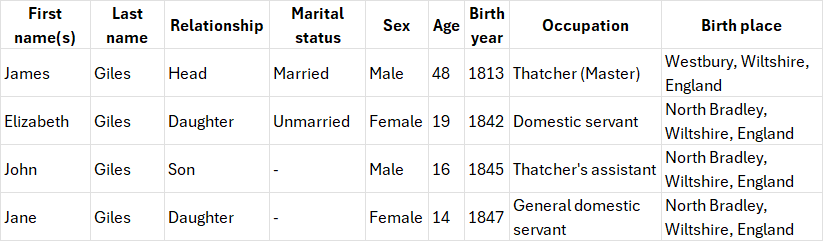
At the age of 16 he is well into his work as a thatcher, assisting his father, whose occupation is given as ‘Thatcher (Master)’.
I looked further into John Giles through the British Newspaper Archive: I discovered he was an active member of the local parish council, being elected at least once in 1894 (along with several other familiar names, including Arthur Culverhouse), and then stumbled across a great write-up of an interview by E. Hale in ‘Wiltshire News’ in September 1929, towards the end of John’s life at the mighty age of 86:
VETERAN THATCHER
Mr. John Giles of North Bradley
WORK ON ROYAL ESTATES
“We’ve been a thatching family hereabouts for a matter of 200 years, I should say,” remarked Mr. John Giles, who resides at The Rank, North Bradley, Trowbridge. He is a wonderful veteran, now in his 86th year. He has been a thatcher all his life and says he intends to die a thatcher. Indeed, he is trying to keep young by doing thatching, although naturally he does not work as hard as formerly.
It is his proud boast that he has thatched on Royal estates, and has covered everything of a thatchable character, from a 60-ton rick to a hen-roost.
Wiltshire News, Friday 20 September 1929
Only the census of 1861, and those following it, give us any idea of the Giles family’s involvement in thatching, but luckily, their reputation means that there is more than enough coverage of John’s life and work in the newspapers.
Another article from 1907 in the Somerset Herald discusses the decline of the craft, and even goes so far as to point to John as something of a philosophical ideal:
IS THATCHING GOING OUT?
Thatching, which for ages has been such an exceedingly useful craft in rural districts, would appear to be doomed ere long to extinction. It is not only that the younger agricultural labourers do not take kindly to learning it, but modern substitutes have to a great measure led to the disuse of straw for protective purposes. Tiles are cheaper now than in the days when every landlord thatched his cottages, and the farmers who shield their hay mows with corrugated iron roofs are very much on the increase.
[…]
There is a thatcher of more than local repute in the village of North Bradley, near Trowbridge, bearing the distinctly bucolic name of John Giles. Giles fairly revels in his handicraft, and, what is more, he is so skilled in the use of the straws as to be able to introduce ornamental designs in his roofings with great effect. The old thatcher’s ability has earned for him Royal employ on more than one occasion. Giles is an exceedingly intelligent man, and a visit to his bright little cottage quite repays the time it takes. Alas! that the ready-handed, self-reliant type of peasantry once Britain’s boast, of which Giles is a type, is, like thatching, so rapidly passing away.
Somerset Herald, Friday 28 June 1907
From this article, John’s cottage on The Rank sounds almost like a tourist attraction, something to visit and admire. This might have been what compelled E. Hale to visit, and further in the interview for Wiltshire News in 1929, the writer describes visiting John at home:
IN HIS “CASTLE”
[…] Together we toddled – at least, John did with the aid of a good old countryman’s stick – through the garden, commenting as we went upon the season’s produce ripening off – potatoes here, onions there.
Through a devious path he piloted me, and we eventually arrived at John’s “Castle”. One might have imagined that one was in a log cabin in the backwoods of Canada, or somewhere with its age-worn oak posts of great bulk supporting a low-eaved, thatched roof.
We entered. John sat himself down on his accustomed padded perch, I on an improvised seat, a trifle less comfortable. Entering from the sunlight it was some moments before my eyes accustomed themselves to the strange surroundings amid the straw, the chippings and what not. To me it appeared a very haven of refuge, “far from the madding crowd’s ignoble strife.” And yet hardly so, for in the lane not many yards away could be heard the prattle of the children homeward bound from school.
This is an amazing glimpse into the atmosphere of The Rank in the 1920s (and the group of schoolchildren could have included my own great-grandparents and their siblings and friends).
But what about the Royal commission these journalists keep referring to? The article explains further:
For many years John’s work lay in his own country. He travelled many miles to and from work, his daily subsistence being, as he put it, “a glass o’ good beer and a crust o’ bread and cheese.”
And then came a day which was to mark the beginning of greater things and which eventually brought him under the notice of responsible authorities of the Royal Estates. It came about in this way: He was engaged in thatching the beer cellars at the brewery premises of Messrs. Fuller, Smith and Turner at Chiswick.
“I suppose they took a fancy to my work,” said John, “but, howsomeever, they asked me if I would come up and do the thatching at Kew Gardens? I thought ’twere kind of ’em, and after thinking it over I said I would, and that’s how I came to thatch the Queen’s Cottage at Kew. That was there Queen Victoria used to play in her young days.
The Queen’s Cottage at Kew is now better known as ‘Queen Charlotte’s Cottage’. It was built for Queen Charlotte in 1772, in the grounds of what is now Kew Palace. It is a ‘cottage orné’, an ornamental building designed to delight guests visiting the palace and roaming its grounds. Furthermore, it offered accommodation as a lodge, with every 18th-century convenience and comfort beneath its rustic exterior.
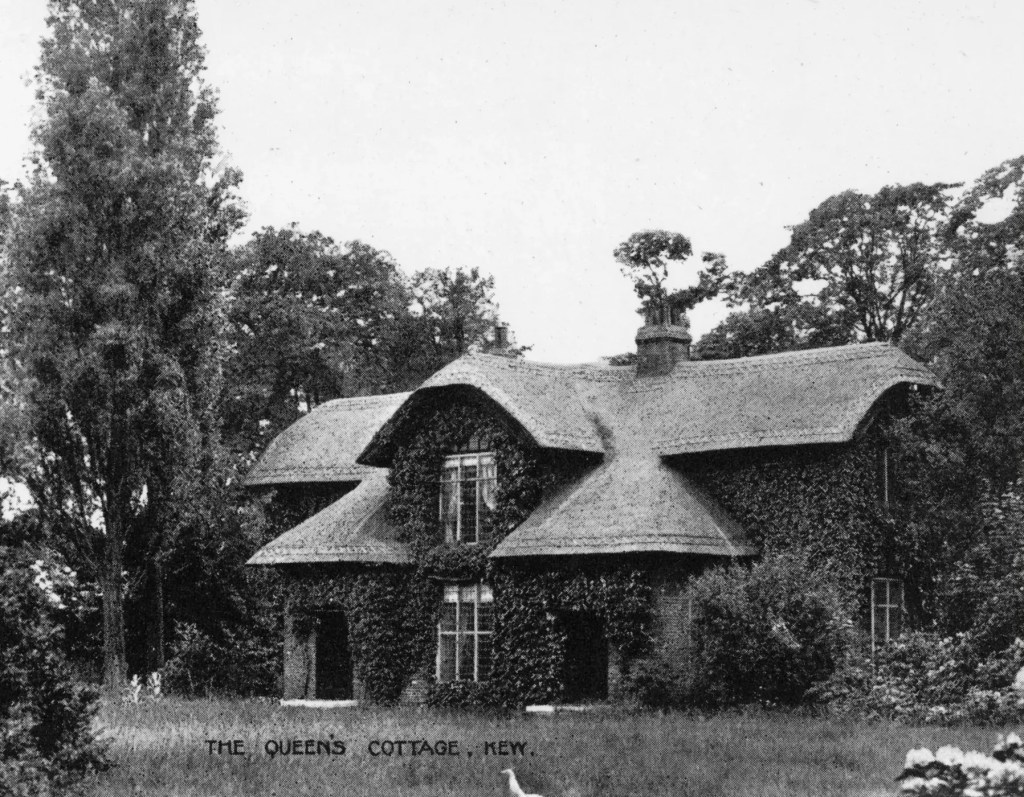
The Queen’s Cottage, Kew, in the late 1800s. Given the date, this photo may well show John’s thatching work itself (Kew Gardens in Pictures, Then and Now)
The architectural style of the cottage is closer to the cottages that Queen Charlotte would have known from growing up in Germany, than to the Wiltshire cottages that John would have worked on up until that point.
Architecture wasn’t the only thing about London that surprised John:
London surprised him in that he found everybody he came into contact with were honest. He put it this way: “I thought ‘twouldn’t be safe to change half a suv’rin’, for fear I might be done out of it. But everybody was nice.”
Having myself recently paid £3.90 for a croissant in a branch of Pret in London, I can see what John was worried about.
John must have felt like a fish out of water in London, and he goes on to describe his encounters with the innkeepers:
John also spoke very appreciatively of an innkeeper whom he was wont to visit, and, incidentally, with his robust Wiltshire personality, helped to draw the mighty crowd.
“Landlord used to say,” explained John, “‘You chaps (addressing the customers) can have all the games and pranks you want, but don’t try it on with the old countryman!’ I thought that was very kind of him.”
It seems he enjoyed being an object of fascination: proud of his status as a master craftsman, and of talking about his work:
While he was talking John toyed with a useful looking bill-hook, his companion in hut for the last 50 odd years. John is left handed and so I had to examine it left handed too. There are deep grooves work by the use of his thumb on one side and his forefinger on the other.
He chatted upon other objects of interest such, for instance, a 70 year-old ladder, still borrowed by neighbours like the lawnmower; of the 40-year-old “Castle”, built in conjunction with his wife who passed away forty years ago; of his much sought-of market for “spicks”; of how he had been a non-smoker all his life – “‘twouldnt do for a thatcher to smoke”, was how he put it; of how he worked twenty hours a day and fifteen “of our days” a week; of his early starts – off at two in the morning and late returns home.
John, described as an exceedingly intelligent man, knew full well his craft was rapidly becoming a thing of the past, however:
Finally, placing the hook in the side of the straw he observed “That’s nearly had its day, the same as I”.
John Giles died on 15th November 1932, and the following obituary appeared in Wiltshire News shortly afterwards (a similar tribute was published in newspapers as far away as Dundee):
“THE KING’S THATCHER”
Death of Mr. John Giles, of Bradley
A notable Wiltshire native has passed away in Mr. John Giles of North Bradley, Trowbridge, at the age of 88 years. He had been lain aside only a fortnight, and a peaceful ending came on Tuesday. His wife predeceased him many years ago, and he had for a long time been in the care of one of his daughters.
Mr. Giles was one of the very few remaining thatchers of the old school. He was an expert in this work, and was much sought after. His greatest pride was in the fact that he was chosen to thatch the buildings on the Royal estates, among them Queen Victoria’s cottage at Kew. He delighted to relate his experiences and of the incidents which happened during his absence from home in the fulfilment of Royal command.
Wiltshire News, Friday 18 November 1932
In the 1929 interview he remarked that “he had been a thatcher all his life, and he intended to die a thatcher”. Given that he had only retired from his work a fortnight before he passed away, he achieved that aim, fair and square.
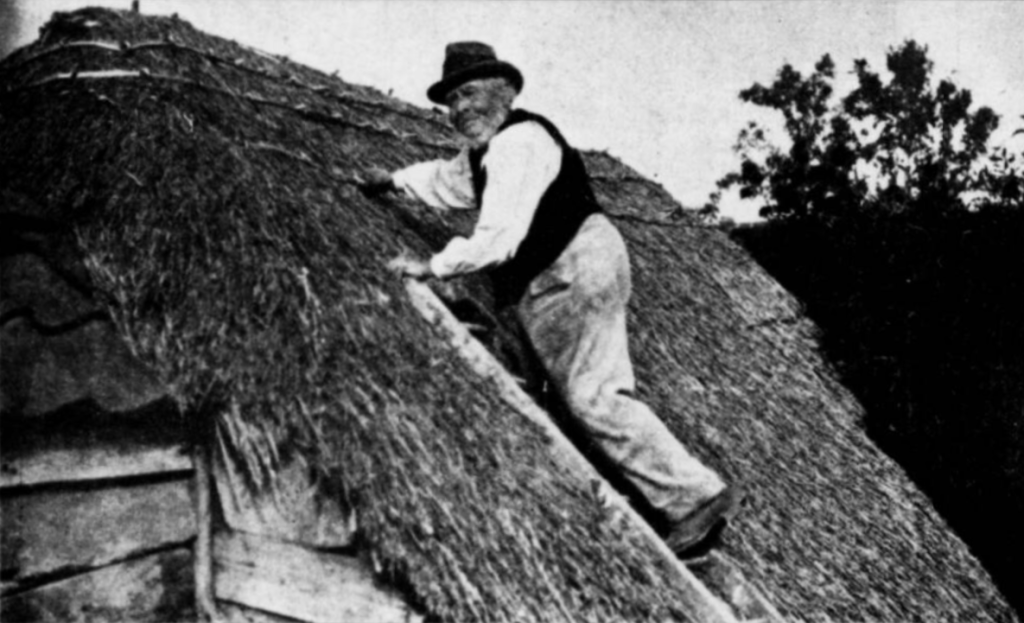
Postscript: For more detailed information and some amazing photos of thatched cottages in Wiltshire, see ‘Thatching in Wiltshire’ on ThatchInfo.com.


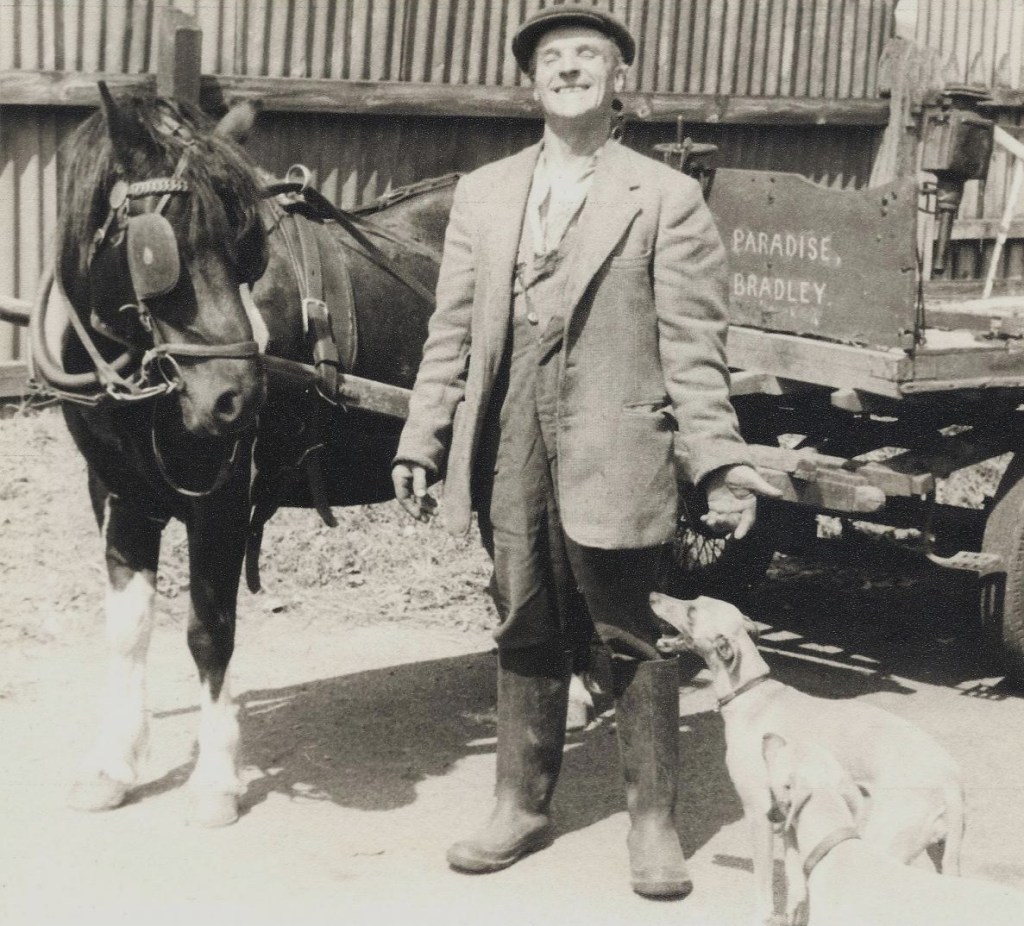
 The Rank, North Bradley | One-Place Study
Leave a comment