The families of The Rank were, for many years, associated with wool weaving. Many of the households on the census returns over the decades give indications that the families were working in the wool and cloth industry, either at home, or – later – in the factories in nearby Trowbridge. The common land in the parish may have been what initially attracted the weavers and their families to North Bradley, where they were able to build cottages and keep animals on it. It was around this time in the late 18th and early 19th centuries that the population of North Bradley parish reached a peak.1
The cottages that still remain to this day are likely to have been occupied by weavers who worked from home (how times change…!) on hand-powered looms. These would be rented from their employer, and worked by the skilled worker and their family to produce woven cloth from spun wool prepared elsewhere (perhaps in a spinner’s cottage, or later, a spinning mill) and brought into the house.
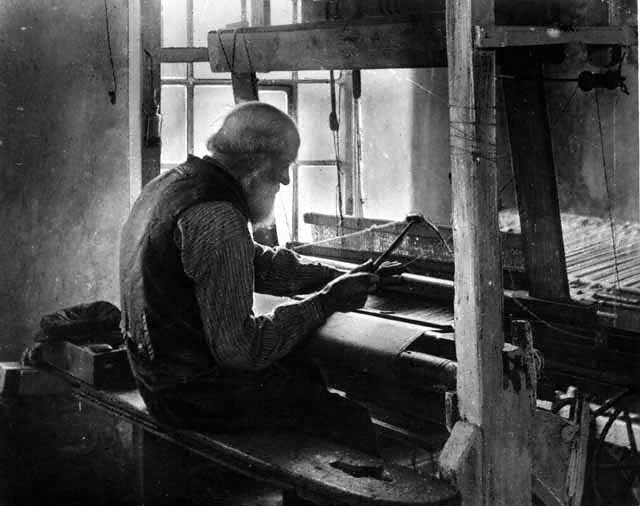
The Rev. J Wilkinson, writing in 1860, described the weavers of Broughton Gifford (a village the other side of Trowbridge from North Bradley) working from their own homes:
The cottages are abundant, but the dwelling rooms are few and small (the weavers devote the best lighted and largest apartments to their shops), Our hand-loom weavers, whose numbers are rather more than half our agriculturists, work at their own homes, in their weaving “shops,”, many hours for little money. When in full employment they are fourteen hours a day at it, hands, arms, legs, and feet in full play.
Rev. J Wilkinson goes on to describe the low pay that a weaver could expect:
A good weaver can turn out four, five, or six yards [of cloth] per day, for which he receives 10d., 8d., or 6d. per yard. But this is not all profit. He has to pay perhaps two children, at least one to change shuttles for him. Another child “quillies.” Besides, he is subject to deductions for all faults. Nor is he thus employed every day.
If trade be very brisk, he may reckon on five days of such work each week: often he has to be content with three, or none.
A child being employed as a ‘quiller’ (where wool yarn is wound onto spools for the loom) is seen several times in the census returns for The Rank, and always where one or both of their parents are hand loom weavers.
However, this was also a job for older women; in 1851, Jane Harding is doing this work at the age of 77. On the opposite side of the age spectrum, 6-year-old Lydia Slatford is put to work, helping her mother Leah, her father Job, and her older brother Daniel at their looms, alongside her sister Ann.
The entire Slatford household in 1851 is engaged in weaving and cloth working, and the same is true for other households on The Rank at that time. Out of all 27 households on the census, 23 are involved in some kind of textile work. Of these, 17 households have every member of the family (besides the very young children) employed in this work, as either ‘Hand loom weaver, cloth’, or ‘Quiller’.
In 1861, 31 households are enumerated, and of these 28 are doing textile work. Once again, the Slatford family are all involved in the trade, as far as possible. The household is now headed by Jesse Slatford, his wife, and their eight children; both Jesse and his wife Ann are weavers, along with their 14-year-old son Thomas, and the next three children are all wool winders (i.e. quillers). The four youngest are at school (however, baby Sidney is only a year old at this point so is neither at school, nor any help with the weaving!).
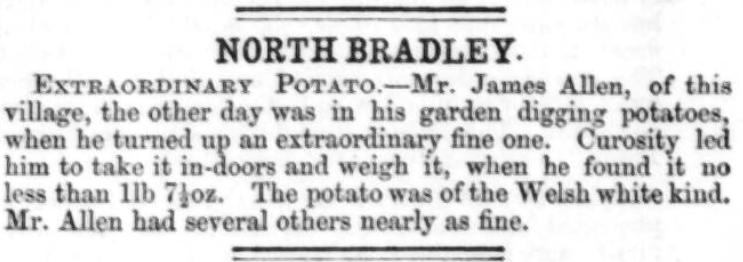
However, occupations are beginning to show signs of diversifying at this point: there are 10 agricultural labourers (up from 6 in 1851), and others in other occupations such as Jane Moore (a dressmaker) her sons John and James (an engineer and a blacksmith, respectively), Tom Harding and John Alford (both railway labourers), Daniel Pauley (a coachman), Henry Bennett and his son Tom Bennett (a blacksmith, and an apprentice blacksmith), and James Allen, a grocer.
The picture changes dramatically by 1881, as a sharp distinction becomes apparent between those who can find work in the Trowbridge factories, and those who can’t. Out of a total of 109 people living on The Rank, 24 are cloth workers – however, only 10 are actually employed. The rest are ‘formerly’ weavers, or weavers that are ‘unemployed’, and – tellingly – they are listed as hand loom weavers. The weavers who are employed all work power looms, and would have travelled to work in one of the factories in Trowbridge, rather than at home2.
The wool weaving industry lingered on in Trowbridge into the early 20th century, and on The Rank in 1911 a handful of residents are still working in the industry. Among them is Sidney Slatford, now 50, living in the same house where he was born, and where his entire family worked their weaving looms in 1861. The main difference compared to fifty years prior, is that he works in a cloth factory, rather than his own home, and the occupation that was near-ubiquitous across all the houses on The Rank had become confined to the factories of the nearby town only.
Today, the legacy of the weaving industry in and around Trowbridge is immortalised not only in Trowbridge Museum, but also in the Trowbridge Weaver’s Market – not, as the name suggests, a market dedicated to the trade of weavers, but a vibrant community-led market for ‘independent, local artisan and craft traders’, which is no bad thing, every bit as good as the craft of weavers of centuries past!
References
1 A History of the County of Wiltshire: Volume 8, Warminster, Westbury and Whorwellsdown Hundreds. Originally published by Victoria County History, London, 1965. Accessed 16th October 2024
2 Trowbridge Museum. Accessed 16th October 2024


 The Rank, North Bradley | One-Place Study
Leave a comment